Preobrazhenski Monastery – Near Veliko Tarnovo
Location: Near Veliko Tarnovo, Bulgaria
Type: Orthodox Monastery / Bulgarian Revival Heritage / Historic Landmark
Main Facts:
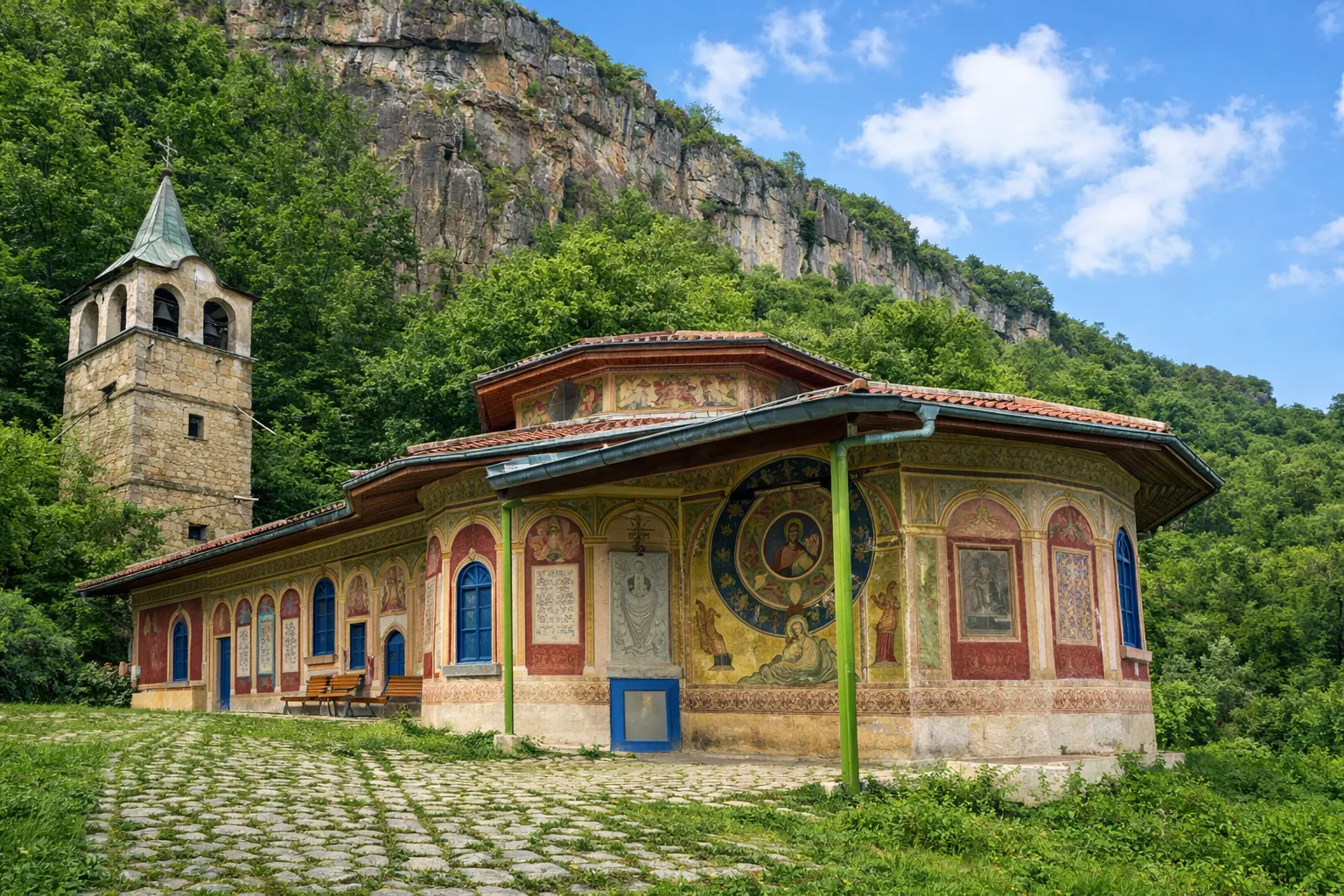
Preobrazhenski Monastery is one of the most important monasteries in the Veliko Tarnovo region. It stands in the wooded Derventa Gorge, about 7 km from the city, beneath the rocky slopes of the Belqkovsko Plateau.
The monastery has medieval origins and became an important religious centre during the Second Bulgarian Empire. Its present complex was largely rebuilt during the Bulgarian Revival in the 19th century.
Today, Preobrazhenski Monastery is especially famous for the work of two major Bulgarian Revival artists. Master builder Kolyo Ficheto shaped much of the monastery’s architecture, while Zahari Zograf created its remarkable frescoes.
The peaceful location, historic buildings and mountain scenery make the monastery a popular stop near Veliko Tarnovo.
History of Preobrazhenski Monastery:
The monastery is believed to have been founded in the 11th century as a dependency of Vatopedi Monastery on Mount Athos.
Later, around 1360, it became an independent monastery. During the Second Bulgarian Empire, the monastery received important support from Tsarina Theodora-Sara and her son, Tsar Ivan Shishman.
After centuries of destruction and rebuilding, the monastery was established at its present location during the 19th century. Father Zotik, a monk from Rila, played an important role in its revival from 1825 onwards.
Construction of the main Church of the Transfiguration began in 1834. Master Dimitar Sofiyanliya started the work, but after his death, Kolyo Ficheto continued and completed important parts of the complex.
Further buildings were added during the following decades. As a result, much of what visitors see today dates from the Bulgarian Revival period.
Architectural Importance:
Preobrazhenski Monastery is closely associated with Kolyo Ficheto, one of Bulgaria’s most important 19th-century master builders.
He completed major sections of the monastery, including the south-eastern wing and the main entrance. In 1861, he also built the distinctive bell tower with its clock.
The monastery church has a relatively simple exterior, but its interior is far more impressive. The iconostasis features detailed wood carving, while the walls are covered with colourful frescoes.
One of the most famous paintings is Zahari Zograf’s “Wheel of Life”. Painted in the 19th century, it presents the different stages of human life in a dramatic and highly recognisable composition.
Zahari Zograf also painted many of the church’s major icons. His work makes Preobrazhenski Monastery an important destination for anyone interested in Bulgarian religious art.
Historical Importance:
Preobrazhenski Monastery played an important role in Bulgarian religious and cultural life.
During the Bulgarian Revival, monasteries were important centres of education, religious activity and the preservation of Bulgarian identity. Preobrazhenski Monastery was part of this wider movement.
During the Russo-Turkish War of 1877–1878, a military hospital was established in the monastery. After the Liberation, Russian soldiers donated bells, chandeliers and religious books to the monastery.
The complex also survived a major rockfall in 1991. Large rocks fell from the cliffs above the monastery and destroyed part of the monastic buildings, but the main church was not damaged.
What to See:
- Church of the Transfiguration
- Zahari Zograf’s “Wheel of Life” fresco
- Other frescoes by Zahari Zograf
- Historic iconostasis and carved Royal Doors
- Bell tower with clock by Kolyo Ficheto
- Main monastery entrance and colonnade
- Church of the Annunciation
- Historic monastic buildings
- Mountain and forest scenery around the monastery
Best Time to Visit:
Preobrazhenski Monastery can be visited throughout the year. Spring and autumn are particularly pleasant because the surrounding woodland adds to the experience.
Summer is also a good time to visit, especially in the morning or late afternoon when temperatures are more comfortable.
The monastery is a working religious complex. Therefore, visitors should dress respectfully and keep noise to a minimum.
What to Visit Nearby:
- Veliko Tarnovo
- Tsarevets Fortress
- Trapezitsa Fortress
- Samovodska Charshia
- Arbanasi
- Patriarchal Monastery of the Holy Trinity
- Kilifarevski Monastery
Quick Travel Information:
Preobrazhenski Monastery is around 7 km from Veliko Tarnovo and takes about 15–20 minutes to reach by car.
The monastery is open to visitors every day, generally from 07:00 to 19:00.
Allow around 45–60 minutes for a visit. The monastery can easily be combined with Tsarevets Fortress, Arbanasi or other nearby attractions for a half-day tour.
The approach includes a narrow mountain road, so drive carefully, especially in wet or winter conditions.
Useful Links:
- Google Maps – Preobrazhenski Monastery
- Official Website – Veliko Tarnovo Tourism
- Weather Forecast – Veliko Tarnovo
Related Tours including Preobrazhenski Monastery :