Thracian Heritage in Bulgaria – Ancient Sites, Tombs and Treasures
Location: Across Bulgaria
Type: Ancient Heritage / Archaeology / Thracian Culture
Main Facts:
Thracian heritage is one of the most fascinating parts of Bulgaria’s ancient past. Across the country, visitors can discover monumental tombs, sacred sites, ancient cities, royal treasures and remarkable works of art connected with the Thracian peoples.
The Thracians were not a single unified nation or kingdom. Instead, the ancient sources describe many tribes and regional groups. Some remained independent, while others became part of larger political structures such as the Odrysian Kingdom.
Their heritage extends far beyond the famous tombs around Kazanlak. Northern Bulgaria was home to important Getic and Triballian communities, while the Rhodopes were associated with groups such as the Bessi. The central and southeastern regions became important centres of Odrysian power.
Today, this ancient heritage can be explored through archaeological reserves, museums, tombs, sanctuaries and ancient settlements.
Two of Bulgaria’s Thracian monuments are UNESCO World Heritage Sites: the Thracian Tomb of Kazanlak and the Thracian Tomb of Sveshtari.
Who Were the Thracians?
The term “Thracians” describes a large collection of ancient peoples who lived across much of southeastern Europe.
They were known for their horsemanship, metalworking, warfare, agriculture and craftsmanship. However, they were politically divided, and different groups developed their own traditions and centres of power.
Much of what we know about them comes from archaeology because only limited written evidence survives from Thracian sources themselves.
Tombs, sanctuaries, settlements, weapons, jewellery, coins and ceremonial objects therefore play a major role in understanding their world.
The ancient Thracian world also extended beyond modern Bulgaria into parts of northeastern Greece and European Turkey. At its western and southwestern edges, Thracian communities interacted with neighbouring peoples such as the Macedonians, Paeonians and Illyrians. These groups had their own identities and should not simply be classified as Thracian.
Thracian Tribes and Kingdoms
Odrysians and the Odrysian Kingdom
The Odrysians became the most powerful Thracian political group in the 5th and 4th centuries BC.
Their kingdom controlled a large part of southeastern Bulgaria and expanded its influence over neighbouring Thracian communities. Several important rulers are known from ancient sources, including Teres, Sitalces, Cotys I and Seuthes III.
Seuthes III later founded Seuthopolis, which became one of the most important political centres of the Thracian world.
Getae
The Getae were especially important in northern Bulgaria and the Lower Danube region.
Their history is closely connected with northeastern Bulgaria, where they developed powerful communities and elite centres. The Sboryanovo archaeological reserve and the Thracian Tomb of Sveshtari provide some of the best evidence of their culture.
Triballi
The Triballi were an important Thracian group associated mainly with the lands around the Morava and northwestern Balkan region.
Ancient writers describe them as a powerful population involved in conflicts with Macedonian rulers and neighbouring peoples.
Their wider cultural area is important when exploring the ancient heritage of northwestern Bulgaria, while discoveries such as the Rogozen Treasure provide an insight into the wealth of the local elite.
Bessi
The Bessi were one of the best-known Thracian groups of the Rhodope region.
Ancient sources connect them with the mountains and with important religious traditions. Their territory helps explain the concentration of ancient sanctuaries and sacred landscapes found throughout the Rhodopes.
Thracian Kingdoms and Ancient Centres
Seuthopolis
Seuthopolis was founded by King Seuthes III in the late 4th century BC.
The city was carefully planned, with streets, houses, fortifications, public buildings and religious structures. It became the political centre of the Odrysian ruler.
Today, Seuthopolis lies beneath the waters of Koprinka Reservoir. However, its surrounding royal necropolis survives and forms the heart of the Valley of the Thracian Kings.
Kabyle
Kabyle near Yambol was one of the most important ancient settlements in southeastern Bulgaria.
The site has a long history and later developed under Macedonian and Roman influence. Today, the archaeological reserve preserves fortifications, religious buildings and other remains.
Heraclea Sintica
Heraclea Sintica near Rupite developed in a region where Thracian, Hellenistic and later Roman influences met.
Archaeological excavations have revealed streets, public buildings, inscriptions and other remains from the ancient city.
Perperikon
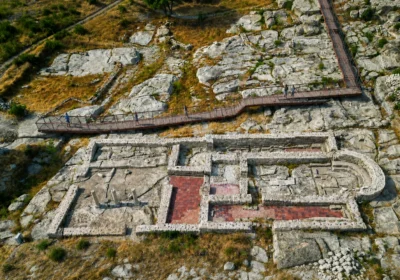
Perperikon in the Eastern Rhodopes is one of Bulgaria’s most spectacular archaeological complexes.
The enormous rocky site contains temples, monumental buildings, streets and fortifications. Its origins are strongly connected with Thracian religious activity.
Its dramatic location on a rocky hill also makes Perperikon one of the most memorable archaeological sites in Bulgaria.
Thracian Tombs and Royal Necropolises
Thracian tombs are among the most recognisable elements of Bulgaria’s ancient heritage.
Many were built for rulers or members of the elite and contain long corridors, circular burial chambers, domed roofs, decorated walls and valuable offerings.
Thracian Tomb of Kazanlak – UNESCO World Heritage Site
The Thracian Tomb of Kazanlak is one of Bulgaria’s most famous ancient monuments.
Dating from the Hellenistic period, around the end of the 4th century BC, it has a narrow corridor and circular burial chamber decorated with remarkable frescoes.
The paintings show a funeral ceremony and are considered an exceptional example of Hellenistic funerary art.
Because the original tomb is carefully protected, visitors normally enter a replica nearby. The monument was inscribed on the UNESCO World Heritage List in 1979.
Thracian Tomb of Sveshtari – UNESCO World Heritage Site
The Thracian Tomb of Sveshtari dates from the 3rd century BC and lies in the Sboryanovo archaeological reserve.
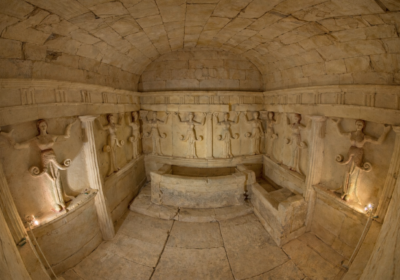
Its central chamber contains ten carved female figures with human and plant features. These unusual caryatids are among the most distinctive examples of Thracian funerary art.
The monument is closely connected with the Getic Thracian culture of northeastern Bulgaria and was inscribed on the UNESCO World Heritage List in 1985.
Golyama Kosmatka Tomb
Golyama Kosmatka is one of the most important monuments in the Valley of the Thracian Kings.
The complex contains several chambers and a long entrance corridor. Archaeologists discovered a golden wreath, ceremonial vessels, weapons and other valuable objects.
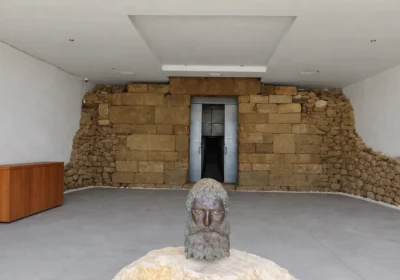
A bronze head of a ruler was also found near the entrance. The monument is strongly associated with Seuthes III, although the identification remains an archaeological interpretation.
Shushmanets Tomb
The Shushmanets complex near Shipka has an unusual circular burial chamber with a domed ceiling and central column.
Built in the 4th century BC, the monument combines funerary and religious features. Evidence of ritual activity, including animal sacrifice, was also discovered.
Ostrusha Tomb
Ostrusha is famous for its richly decorated stone ceiling.
The panels contain portraits, animals, plants and geometric designs. As a result, the tomb provides an excellent example of the artistic quality achieved by Thracian craftsmen.
Aleksandrovo Thracian Tomb
The Aleksandrovo Tomb near Haskovo contains some of Bulgaria’s most important Thracian wall paintings.
Hunting scenes, human figures and animals provide valuable evidence of Thracian art and beliefs.
A nearby museum and replica help visitors understand the monument while protecting the original paintings.
Mezek Thracian Tomb
Near the village of Mezek in southern Bulgaria stands one of the country’s best-preserved Thracian beehive tombs.
Its long corridor leads into a circular burial chamber covered by a large stone dome. Gold, bronze, glass and ceramic objects were discovered inside.
The nearby Mezek Fortress also makes the area particularly worthwhile for a historical trip.
Ancient Dome Tomb of Pomorie
The Ancient Dome Tomb of Pomorie is a very different example of Thracian heritage.
Dating from the Roman period, around the 2nd–3rd centuries AD, the monument is believed to have served as a mausoleum or heroon for a wealthy local Thracian family from ancient Anhialos.
A 22-metre-long corridor leads into a large circular chamber measuring about 11.6 metres across. The most unusual feature is the hollow central column that rises towards the domed roof.
The monument combines Roman construction techniques with local Thracian funerary traditions, showing how ancient cultural traditions continued during the Roman period.
Thracian Sanctuaries and Sacred Landscapes
Thracian heritage is not limited to burial monuments. Sanctuaries and ceremonial complexes are equally important.
Starosel Thracian Cult Complex
Starosel contains one of Bulgaria’s largest known Thracian cult complexes.
The temple at Chetinyova Mogila has a monumental entrance, ceremonial spaces and carefully constructed stone walls. The wider area contains several underground temples and royal burials.
Another important site nearby is the Horizon Temple, one of the few known Thracian temples with a colonnade.
Tatul Sanctuary
The rock sanctuary near Tatul in the Eastern Rhodopes contains carved stone structures and ceremonial features.
The site has sometimes been associated with the legendary Orpheus. However, this connection belongs to later tradition rather than established archaeological evidence.
Beglik Tash
Beglik Tash lies near Primorsko on the southern Black Sea coast.
Large natural rocks form the centre of this ancient sanctuary, where carved stones and ceremonial spaces reveal how the landscape was used for religious activities.
Its coastal location also makes it easy to combine with a Black Sea holiday.
Zhaba Mogila – Frog Mound Tomb
Near Strelcha, the Zhaba Mogila, or Frog Mound Tomb, is one of the largest Thracian burial mounds in the region.
The complex has both a mausoleum and a temple, with a large surrounding mound and former water-filled moat.
Unlike many smaller burial sites, Zhaba Mogila appears to have served as a major ceremonial complex, making it an interesting addition to the Thracian heritage route.
Thracian Treasures
Bulgaria is famous for its spectacular Thracian treasures.
Panagyurishte Treasure
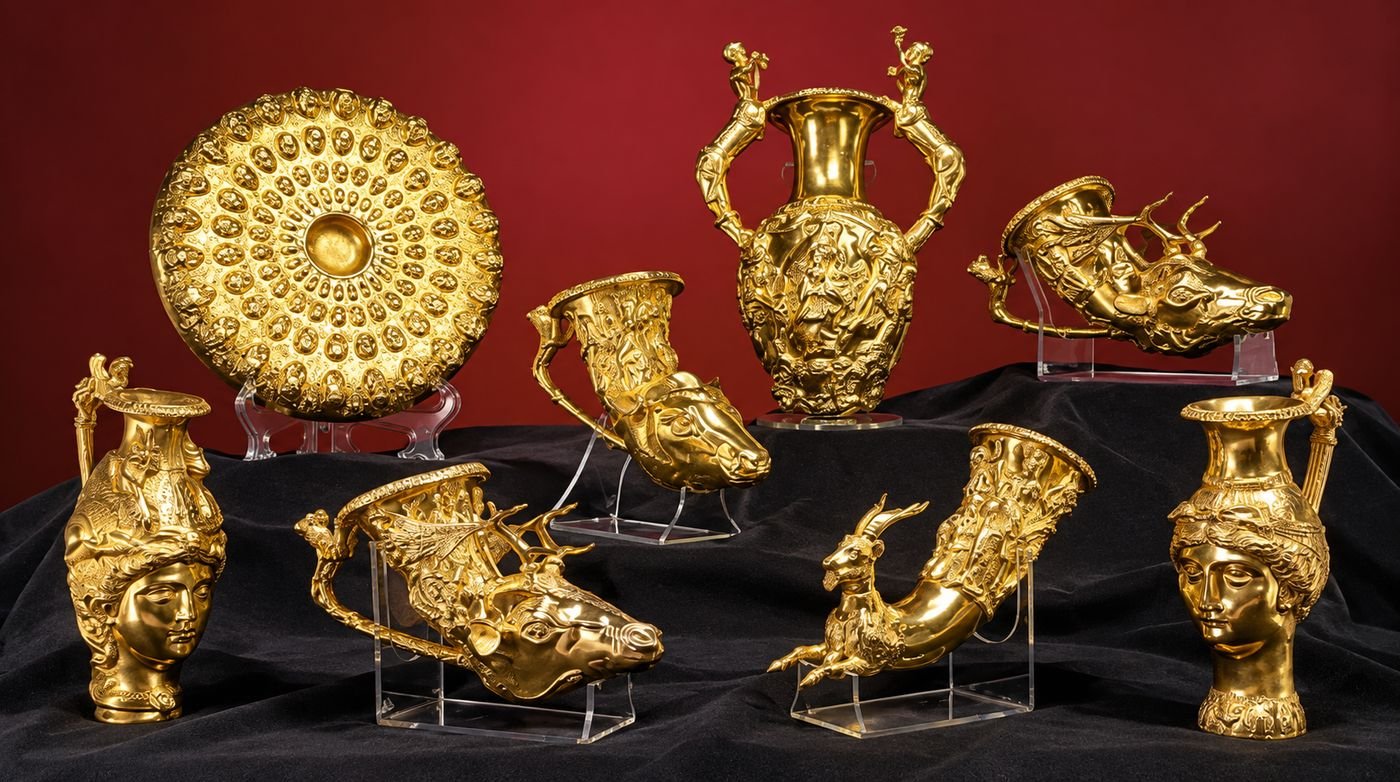
The Panagyurishte Treasure is one of Bulgaria’s most famous archaeological discoveries.
The collection consists of richly decorated gold vessels featuring human figures, animals and scenes from Greek mythology.
Its craftsmanship demonstrates the wealth of the Thracian elite and their close artistic connections with the wider Hellenistic world.
Rogozen Treasure
The Rogozen Treasure consists of more than 100 silver vessels discovered in northwestern Bulgaria.
The collection includes bowls, cups, jugs and other richly decorated objects. It is one of the largest groups of ancient Thracian silver vessels ever discovered.
Borovo Treasure
The Borovo Treasure contains five richly decorated silver vessels.
Several objects bear inscriptions associated with the Thracian ruler Cotys I, making the collection particularly valuable for understanding Thracian political and artistic history.
Letnitsa Treasure
The Letnitsa Treasure includes silver objects and an elaborate horse harness decorated with mythological figures.
The discovery highlights the importance of horses, warriors and elite culture in Thracian society.
Valchitran Treasure
The Valchitran Treasure is an extraordinary collection of gold vessels discovered near Pleven.
Its bowls, cups and other objects demonstrate the advanced metalworking skills of ancient communities in the region.
Thracian Art and Architecture
Thracian art developed through a mixture of local traditions and influences from the wider ancient Mediterranean world.
Gold and silver vessels often feature animals, mythical creatures, human figures and elaborate patterns.
Tomb paintings provide another important source of evidence. The frescoes at Kazanlak and Aleksandrovo show people, ceremonies, hunting scenes and symbolic imagery.
Architecture is equally impressive. Some tombs contain massive stone corridors and domed chambers, while sanctuaries were often built around natural rocks or integrated into mountain landscapes.
These monuments demonstrate advanced craftsmanship and considerable organisation among the communities that built them.
Thracian Heritage Beyond Modern Bulgaria
The ancient Thracian world extended beyond the borders of modern Bulgaria into parts of northeastern Greece and European Turkey.
At its western and southwestern edges, Thracian communities interacted with neighbouring peoples such as the Macedonians, Paeonians and Illyrians. These groups had their own identities and should not simply be classified as Thracian.
This wider geographical context helps explain the complexity of ancient Balkan history. Modern national borders do not correspond to the political and cultural boundaries of antiquity.
For travellers exploring Bulgaria, however, the country contains one of the richest concentrations of surviving Thracian archaeological monuments in the Balkans.
UNESCO Thracian Heritage in Bulgaria
Two Thracian monuments are currently UNESCO World Heritage Sites:
• Thracian Tomb of Kazanlak – UNESCO World Heritage Site
• Thracian Tomb of Sveshtari – UNESCO World Heritage Site
The royal necropolis of the Thracian city of Seuthopolis is on Bulgaria’s UNESCO Tentative List as a proposed serial extension to the Kazanlak property.
The Thracian Tomb beside Aleksandrovo village is also on Bulgaria’s Tentative List.
Being on the Tentative List does not mean that a site already has UNESCO World Heritage status.
Valley of the Thracian Kings
The Valley of the Thracian Kings around Kazanlak contains one of Bulgaria’s greatest concentrations of monumental Thracian tombs.
Golyama Kosmatka, Shushmanets, Ostrusha, Helvetia, the Griffins Tomb and Golyama Arsenalka are among the best-known sites.
The valley can be explored together with Kazanlak, Shipka and the Rose Valley, making it one of the country’s most rewarding archaeological regions.
For a detailed look at the area, see our separate guide to the Valley of the Thracian Kings.
What to See:
• Thracian Tomb of Kazanlak – UNESCO World Heritage Site
• Thracian Tomb of Sveshtari – UNESCO World Heritage Site
• Valley of the Thracian Kings
• Golyama Kosmatka Tomb
• Shushmanets Tomb
• Ostrusha Tomb
• Helvetia Tomb
• Griffins Tomb
• Aleksandrovo Thracian Tomb
• Mezek Thracian Tomb
• Ancient Dome Tomb of Pomorie
• Starosel Thracian Cult Complex
• Zhaba Mogila near Strelcha
• Perperikon
• Tatul Sanctuary
• Beglik Tash
• Seuthopolis archaeological area
• Kabyle Archaeological Reserve
• Heraclea Sintica
• Panagyurishte Treasure
• Rogozen Treasure
• Borovo Treasure
• Letnitsa Treasure
• Valchitran Treasure
Best Time to Visit:
Thracian heritage sites can be explored throughout the year.
Spring and autumn are particularly comfortable for archaeological trips because temperatures are usually pleasant for walking between outdoor monuments.
Summer is also a good season, although early mornings are more comfortable at exposed archaeological sites.
Late spring and early summer are especially attractive around Kazanlak because the Rose Valley is also in season.
Winter can be quieter, although some museums and smaller archaeological sites operate with reduced opening hours.
What to Visit Nearby:
The best nearby attractions depend on the region you choose.
Around Kazanlak, combine the Thracian sites with Shipka Monument, Shipka Memorial Church, the Rose Museum and Buzludzha.
Starosel works well with Hisarya and Plovdiv. Meanwhile, Sveshtari and Sboryanovo can be combined with Razgrad and other attractions in northeastern Bulgaria.
Perperikon and Tatul are well suited to a wider Rhodope itinerary, while Heraclea Sintica works naturally with Rupite, Sandanski and Melnik.
Around Pomorie, the Ancient Dome Tomb can be combined with the Salt Museum, the old town and nearby Nessebar.
Quick Travel Information:
Thracian heritage is spread across Bulgaria, so it is best explored region by region rather than as one long itinerary.
The Valley of the Thracian Kings and Shipka can be visited as a full-day trip from Veliko Tarnovo. Starosel is particularly convenient to combine with Plovdiv and Hisarya.
Visitors based in Sofia can reach several important central Bulgarian sites by car, while northeastern Bulgaria offers a separate itinerary around Sveshtari and Sboryanovo.
The southern Black Sea coast adds another side of Thracian heritage, with Beglik Tash and the Ancient Dome Tomb of Pomorie.
Some tombs and sanctuaries have controlled access because of conservation requirements. Therefore, check opening times and visitor arrangements before travelling.
Useful Links:
• Google Maps – Thracian Heritage in Bulgaria
• UNESCO World Heritage Centre – Bulgaria
• Weather Forecast – Bulgaria