Ancient Synagogue of Philippopolis, Bulgaria – Multi-Day Tour Stop
Location: Central Plovdiv, Bulgaria, near Knyaginya Maria Luiza Boulevard. The surviving mosaic decoration is displayed at the Regional Archaeological Museum, 1 Saedinenie Square, Plovdiv.
Type: Ancient religious building / Roman-era Jewish heritage / Archaeological landmark / Historic mosaic art
The Ancient Synagogue of Philippopolis is one of the most important archaeological discoveries connected with the history of Jewish communities in Bulgaria. Dating from the late second or early third century AD, the building provides evidence of an established Jewish religious community in the ancient Roman city of Philippopolis, present-day Plovdiv.
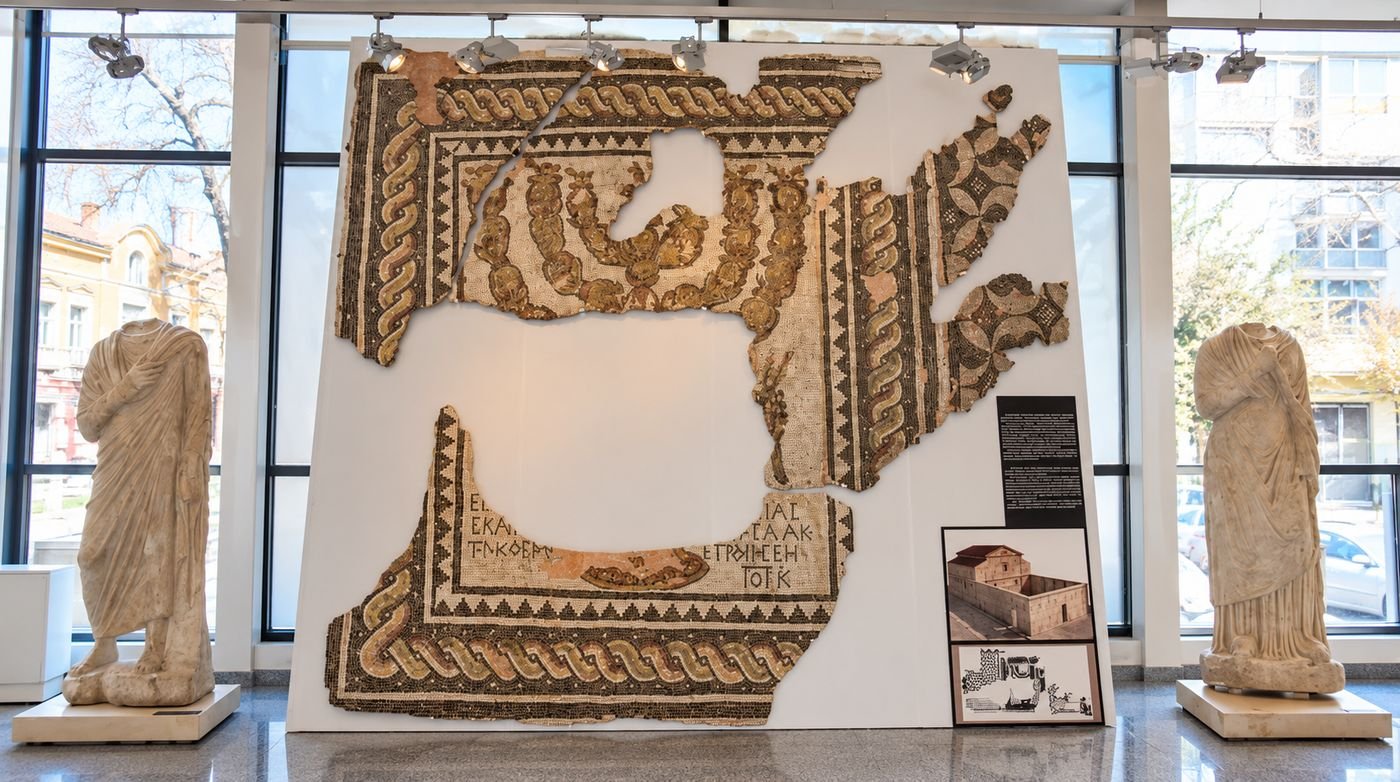
Discovered during archaeological excavations in 1981, the synagogue was a substantial religious building with a basilican layout, several internal rooms and a courtyard. Its most remarkable feature was the decorative mosaic flooring, which included Jewish religious symbols such as the seven-branched menorah and the lulav, together with inscriptions written in Greek.
Although the original remains are not accessible to visitors, sections of the restored mosaic decoration are permanently displayed at the Regional Archaeological Museum in Plovdiv. The synagogue is an important destination for anyone interested in ancient history, Jewish heritage and the multicultural character of Roman Philippopolis. It also makes an interesting addition to a multi-day tour of Plovdiv and its archaeological attractions.
Main Facts:
- Name: Ancient Synagogue of Philippopolis.
- Location: Plovdiv, Bulgaria.
- Historical period: Roman and Late Antiquity.
- Construction: Late second or early third century AD.
- Discovery: 1981, during archaeological excavations.
- Archaeological area: Approximately 650 square metres.
- Architecture: Basilican layout with a central hall, two side rooms and a courtyard.
- Religious community: Jewish community of ancient Philippopolis.
- Important decorations: Mosaic floors featuring a menorah, lulav and Greek inscriptions.
- Later development: Reconstructed and modified during the third and fifth centuries.
- Final abandonment: End of the sixth century.
- Current preservation: Original remains inaccessible; restored mosaic decoration displayed at the Regional Archaeological Museum.
- Historical significance: The only archaeologically investigated ancient synagogue in Bulgaria.
Historical Importance:
The Jewish Community of Ancient Philippopolis
During the Roman period, Philippopolis was one of the most important urban centres in the province of Thrace. Its commercial position and connections with other parts of the Roman Empire attracted people from different cultural, ethnic and religious backgrounds.
The discovery of the ancient synagogue provides archaeological evidence of the presence of a Jewish community in the city during the second and third centuries AD.
The religious building demonstrates that Jewish inhabitants had established a place of worship and maintained their religious traditions within the wider Roman urban environment.
The Greek inscriptions found among the mosaic decorations also provide evidence of the cultural and linguistic environment in which the community lived.
The existence of the synagogue is particularly significant because it is the only ancient synagogue archaeologically investigated in present-day Bulgarian territory, according to the Regional Archaeological Museum of Plovdiv.
Construction and Architectural Layout
The original building was constructed towards the end of the second or beginning of the third century AD, during a period when Philippopolis was experiencing considerable economic and cultural development.
The synagogue occupied part of a residential block within the fortified ancient city and covered an area of approximately 650 square metres.
Its architectural arrangement followed a basilican design, consisting of a central prayer hall flanked by two side rooms. A spacious courtyard occupied the northern section of the complex, possibly including a colonnaded area.
The principal hall was oriented towards the south, facing Jerusalem, in accordance with the traditional orientation of synagogue architecture.
The building was particularly impressive for its decorative interior. The floors were covered with carefully arranged mosaics featuring geometric patterns, religious symbols and dedicatory inscriptions.
The architectural remains indicate that the synagogue underwent several stages of development throughout its existence.
The Mosaic Floors and Jewish Religious Symbols
The mosaic decoration is the most remarkable surviving artistic feature of the Ancient Synagogue of Philippopolis.
The original floor included decorative panels with geometric patterns, Greek inscriptions and important Jewish religious symbols.
The central panel featured a menorah, the traditional seven-branched candelabrum associated with Judaism. It was accompanied by a lulav, a palm branch used during the Jewish festival of Sukkot.
These symbols identify the religious character of the building and provide valuable evidence about the traditions and beliefs of the ancient Jewish community.
The inscriptions written in Greek are also historically important. They demonstrate the use of Greek in the religious and cultural life of Jewish inhabitants in Roman Philippopolis.
The mosaics were created using small coloured stone pieces arranged into decorative compositions. Their craftsmanship reflects the artistic standards of the period and the importance attached to the synagogue’s interior.
Destruction, Reconstruction and Later Development
The archaeological evidence indicates that the synagogue experienced several significant changes during its existence.
During the middle of the third century AD, Philippopolis was affected by Gothic invasions, which caused serious damage to parts of the city.
The synagogue was subsequently reconstructed, and sections of its mosaic decoration were renewed.
A further major rebuilding phase took place during the fifth century. The architectural layout was modified, and a second mosaic floor was installed over the earlier decoration.
Unlike the original floor, the later mosaic design featured mainly geometric and floral patterns without the same prominent Jewish religious symbols.
The synagogue continued to function during Late Antiquity but was eventually abandoned towards the end of the sixth century.
Its successive construction phases make the building particularly valuable for understanding the development of Jewish religious architecture during the Roman and Byzantine periods.
Archaeological Discovery in 1981
The remains of the Ancient Synagogue were discovered in 1981 during rescue archaeological excavations in Plovdiv.
The investigations were connected with construction work on Knyaginya Maria Luiza Boulevard. Archaeologist Elena Kisyakova led the research that identified the remains as an ancient Jewish religious building.
Although the structure was in poor condition, the surviving foundations, architectural arrangement and mosaic decorations provided sufficient archaeological evidence to establish its original function.
The discovery attracted considerable historical interest because it revealed an important aspect of the religious diversity of ancient Philippopolis.
The archaeological investigation also helped document the building’s different construction phases and recover its remarkable mosaic decoration.
What to See:
The Restored Menorah Mosaic
The most important surviving feature of the synagogue is the restored mosaic panel depicting the menorah.
The panel is particularly valuable because it preserves one of the clearest visual representations of Jewish religious symbolism from ancient Philippopolis.
The menorah occupies the central composition, surrounded by decorative elements and geometric borders.
Visitors can examine the workmanship and appreciate how the individual coloured stones were arranged to create the original design.
The panel is displayed in the permanent collection of the Regional Archaeological Museum in Plovdiv, in Hall 6, dedicated to Philippopolis during the Roman period.
Greek Inscriptions and Decorative Details
Another interesting aspect of the synagogue’s surviving decoration is the presence of Greek inscriptions.
These inscriptions provide information about the religious building and its donors, while also demonstrating the importance of the Greek language in the ancient city.
The surrounding mosaic fragments feature geometric ornamentation and carefully arranged decorative borders.
For visitors interested in ancient inscriptions, the surviving fragments offer an opportunity to examine the relationship between religious symbolism, language and artistic expression.
The Archaeological Model and Building Layout
Although the original synagogue cannot be visited, archaeological documentation and plans help explain how the building was arranged.
Its central prayer hall, two side rooms and courtyard provide an interesting example of religious architecture during Late Antiquity.
The museum’s archaeological material helps visitors understand the size and organisation of the complex and how it changed over several centuries.
The original foundations are not open to public access, as their poor condition prevented conservation and presentation in their original location.
It is therefore important to distinguish between the archaeological site and the museum exhibition, where the surviving mosaic decoration can be seen.
The Regional Archaeological Museum of Plovdiv
The Regional Archaeological Museum is essential for understanding the history of the Ancient Synagogue.
Officially opened in 1882, it is one of Bulgaria’s oldest archaeological institutions and houses an extensive collection of objects discovered in Plovdiv and the surrounding region.
Its permanent exhibitions cover prehistoric communities, Thracian culture, Roman Philippopolis and the medieval development of the region.
The synagogue mosaic is particularly interesting when viewed alongside other Roman archaeological discoveries, including coins, sculptures, inscriptions and examples of ancient decorative art.
Hall 6 is the relevant section for visitors wishing to see the restored synagogue mosaic.
Best Time to Visit:
The Ancient Synagogue of Philippopolis can be explored throughout the year through the exhibition at the Regional Archaeological Museum.
Spring and autumn are particularly pleasant seasons for combining the museum visit with a walking tour of Plovdiv’s archaeological attractions and Old Town.
Summer offers longer daylight hours and provides an opportunity to explore the city’s Roman monuments and historic streets.
Winter is also suitable, as the main experience takes place inside the museum.
Visitors should check the museum’s opening schedule before travelling, particularly during public holidays and seasonal changes.
What to Visit Nearby:
Plovdiv has an exceptional collection of Roman, medieval and Bulgarian Revival landmarks. Several attractions can be combined with a visit to the synagogue’s restored mosaics.
- Small Basilica of Philippopolis: An important early Christian monument dating from the fifth century. It is famous for its impressive floor mosaics featuring birds, geometric patterns and Christian symbolism.
- Bishop’s Basilica of Philippopolis: One of Bulgaria’s most important archaeological attractions, featuring extensive early Christian mosaics dating from the fourth to sixth centuries. Its exhibition presents the history and artistic heritage of early Christianity in the region.
- Ancient Roman Forum: The administrative, commercial and public centre of Roman Philippopolis. Visitors can explore the archaeological remains of the ancient square and surrounding buildings.
- Ancient Theatre of Philippopolis: One of the best-preserved Roman theatres in the Balkans, constructed during the first century AD. It remains an important cultural venue for concerts and performances.
- Roman Stadium: Located beneath Dzhumaya Square, this impressive ancient sports facility once accommodated thousands of spectators and hosted athletic competitions.
- Dzhumaya Mosque: A prominent Ottoman-era religious building in the centre of Plovdiv, known for its impressive interior decoration and historical importance.
- Ancient Plovdiv Old Town: A fascinating architectural area featuring Bulgarian Revival houses, cobbled streets, historic churches and traditional buildings.
- Nebet Tepe: An archaeological site on one of Plovdiv’s famous hills, preserving remains of prehistoric, Thracian and medieval settlements.
- Zion Synagogue: A separate historic synagogue in Plovdiv, reflecting the city’s later Jewish heritage. It should not be confused with the ancient synagogue of Roman Philippopolis.
Quick Travel Information:
Location: The original synagogue remains were discovered near Knyaginya Maria Luiza Boulevard in central Plovdiv. They are not accessible to visitors. The restored mosaic panel can be seen at the Regional Archaeological Museum, 1 Saedinenie Square.
Recommended visit duration: Approximately 30–45 minutes to explore the synagogue-related exhibits. Allow 1–1.5 hours for a wider visit to the Regional Archaeological Museum.
The Ancient Synagogue of Philippopolis is particularly suitable for inclusion in a multi-day tour of Plovdiv. The first day can focus on Roman Philippopolis, including the archaeological museum, Ancient Forum, Roman Stadium and Ancient Theatre.
The second day can be dedicated to the Bishop’s Basilica, Small Basilica and Old Town, with time to explore Nebet Tepe and the city’s Bulgarian Revival architecture.
For a longer journey through the region, visitors can continue towards Asenovgrad and Bachkovo Monastery, or explore the Thracian heritage of the Valley of the Thracian Kings near Kazanlak.
The synagogue adds an important Jewish historical dimension to this itinerary, illustrating the religious diversity of ancient Plovdiv and the different communities that contributed to its development.
Useful Links:
- Regional Archaeological Museum – Ancient Synagogue
- Regional Archaeological Museum – Official Website
- Plovdiv – Official Tourism Website
- Ancient Synagogue Mosaic – Location of the Museum on Google Maps
- Plovdiv – Weather Forecast