Rozhen Monastery, Bulgaria – Medieval Heritage and Multi-Day Tour Stop
Location: Near Rozhen village, Sandanski Municipality, Blagoevgrad Province, south-western Bulgaria
Type: Orthodox monastery / Medieval religious heritage / Historic architecture / Cultural landmark
Rozhen Monastery, officially known as the Monastery of the Nativity of the Mother of God, is one of the most important medieval religious complexes in south-western Bulgaria. Situated on the south-western slopes of the Pirin Mountains, approximately 5 kilometres from Melnik, it stands among the distinctive sandstone formations of the Melnik Pyramids.
The monastery is known for its traditional architecture, historic frescoes, wood-carved iconostasis and revered icon of the Virgin Mary. Its irregularly shaped courtyard is surrounded by residential and religious buildings constructed over several centuries. Today, it remains an active Orthodox monastery and an important destination for visitors interested in Bulgarian history, religious art and architecture.
Main Facts:
- Full name: Rozhen Monastery of the Nativity of the Mother of God.
- Location: Near Rozhen village, approximately 5 kilometres from Melnik.
- Historical origins: Medieval, although the exact foundation date is disputed.
- Main church: Nativity of the Mother of God.
- Oldest surviving church fresco: Dated 1573.
- Historic ossuary chapel: Built in 1597.
- Main church reconstruction: Completed in 1732.
- Important religious icon: Holy Mother of God Portaitissa, a copy made in 1790.
- Patronal feast day: 8 September.
- Admission: Free, according to the Bulgarian Ministry of Tourism.
Historical Importance:
Medieval Origins and Despot Alexius Slav
The early history of Rozhen Monastery is not fully documented, and its exact foundation date remains uncertain. Different historical accounts give different dates: the Bulgarian Ministry of Tourism refers to sources from Mount Athos that place its foundation in 890 AD, while Sandanski Municipality and Radio Bulgaria associate its origins with the thirteenth century, during the rule of Despot Alexius Slav.
Alexius Slav was a medieval Bulgarian ruler and nephew of Tsar Kaloyan. His domain included Melnik and the surrounding region, where he established an important political and religious centre. According to the municipal account, the monastery may have been founded around 1217 with donations from residents of neighbouring settlements, including Rozhen, Kurlanovo and Lyubovishte.
Although its precise beginnings remain debated, the monastery’s medieval origins are widely recognised. Its development over subsequent centuries made it one of the most significant spiritual centres in the Pirin region.
Development During the Sixteenth and Seventeenth Centuries
Rozhen Monastery experienced an important period of development during the sixteenth century. The main church and monastic refectory were constructed or substantially developed during this period.
The church was decorated with religious paintings, and the oldest surviving fresco is dated 1573. The monastery also contains valuable woodcarvings and decorative details from different periods.
The complex suffered several fires, particularly during the seventeenth century. These events damaged important sections of the buildings and resulted in the loss of some historical records. The monastery subsequently underwent extensive restoration and reconstruction.
Reconstruction in the Eighteenth Century
Following the destruction caused by fire, the monastery was rebuilt with support from wealthy Bulgarian benefactors and donations from the surrounding region. The main church was completed in 1732, giving the complex much of the appearance associated with its present form.
In 1761, the monastery lost its independence and became subordinate to the Iviron Monastery on Mount Athos. This connection influenced its religious traditions and was associated with the arrival of a copy of the revered icon of the Holy Mother of God Portaitissa.
A Regional Spiritual Centre
During the nineteenth century, Rozhen Monastery became an important religious centre for the wider Pirin region. It owned agricultural land and served local communities through religious services, celebrations and pilgrimage traditions.
The monastery also became connected with Bulgarian revolutionary history through Yane Sandanski, one of the prominent figures of the Macedonian revolutionary movement. His grave is located near the monastery, in the churchyard of the nearby Church of Saints Cyril and Methodius.
What to See:
The Monastic Courtyard and Architecture
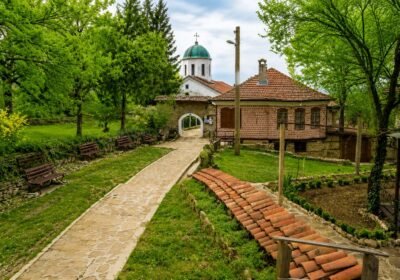
One of the first things visitors notice is the monastery’s unusual layout. The complex has an irregular hexagonal shape, with residential buildings arranged around a central courtyard.
The different sections were constructed over several centuries, creating a combination of architectural features: stone walls, wooden balconies, external staircases, tiled roofs and covered galleries.
The traditional construction style gives the monastery the appearance of a fortified medieval complex. The courtyard is an excellent place to observe the wooden details, old stonework and different architectural periods.
Church of the Nativity of the Mother of God
The main church is the spiritual centre of the monastery and one of its most important architectural features. It is a three-naved pseudo-basilica with an entrance porch and an exterior gallery on its southern side.
The interior is decorated with religious paintings depicting biblical scenes, saints and important events from Christian tradition. The oldest surviving frescoes date from 1573, while additional decorative work belongs to later periods.
The church also contains an impressive carved iconostasis and several valuable religious icons. Its artistic decoration reflects the different periods of development and restoration experienced by the monastery.
The Miraculous Icon of the Holy Mother of God Portaitissa
One of the monastery’s most important religious treasures is the icon of the Holy Mother of God Portaitissa, also known as the Gatekeeper.
It is a copy of the famous Portaitissa icon preserved at the Iviron Monastery on Mount Athos. The Rozhen copy was painted in 1790 by the monk and iconographer Jacob Iversky.
Unlike many other copies, this version is made on sacred iron and is surrounded by ten small compositions illustrating events and healing miracles associated with the icon.
The icon is kept in the chapel dedicated to Saints Cosmas and Damian. It is an important object of veneration for Orthodox Christians, and many pilgrims visit the monastery specifically to pray before it.
The Chapel and Ossuary of Saint John the Baptist
Near the main monastery complex stands a small two-storey building serving as an ossuary and chapel. Dedicated to the Nativity of Saint John the Baptist, it was built in 1597.
The building is particularly interesting because of its preserved traditional architecture and religious paintings. Its original purpose was connected with the burial traditions of the monastery, while its upper chapel served a separate religious function.
The surviving frescoes and architectural features make it an important part of the monastery’s historic ensemble.
The Monastic Refectory
The historic dining room, or refectory, is another significant part of the complex. It is among the older monastery buildings and reflects the everyday life of the monks.
The refectory was used for communal meals and religious gatherings. Its historic character provides an insight into the organisation of monastic life, where worship, work and shared meals followed established religious routines.
Wooden Galleries and Decorative Details
The monastery’s wooden galleries are among its most recognisable architectural features. They extend along sections of the upper floors and connect different parts of the residential buildings.
Visitors can also notice several decorative elements: carved wooden details, traditional doors, old windows and the stonework of the external walls. The combination of timber balconies and stone construction gives the complex its distinctive appearance.
The Grave of Yane Sandanski
The grave of Bulgarian revolutionary Yane Sandanski is located a short distance from the monastery, near the Church of Saints Cyril and Methodius.
Sandanski (1872–1915) was one of the prominent figures of the Macedonian revolutionary movement. The nearby church was built on his initiative, and his grave is situated in its courtyard.
Visitors interested in the modern history of south-western Bulgaria can include the church and grave as a separate stop when exploring the monastery area.
Best Time to Visit:
Spring and autumn are particularly pleasant for exploring Rozhen Monastery and the surrounding countryside. Summer offers longer daylight hours, although temperatures can be high when walking around the Melnik Pyramids. The monastery’s patronal feast is celebrated on 8 September, when religious services and a procession with the revered icon attract many pilgrims.
What to Visit Nearby:
The area around Rozhen Monastery contains several important historical, religious and natural attractions. These places can be included in excursions from the monastery:
- Melnik: Bulgaria’s smallest town, famous for its National Revival houses, traditional wine cellars, local wineries and historic streets.
- Melnik Pyramids: Spectacular sandstone formations surrounding Melnik and nearby villages, with walking routes and viewpoints.
- Kordopulova House: An eighteenth-century merchant house in Melnik, known for its traditional architecture, painted interiors and underground wine cellar.
- Zlatolist and the Church of Saint George: A small village known for its historic church, colourful wall paintings and association with the Bulgarian spiritual figure Venerable Stoina.
- Sandanski: A spa town with mineral springs, the Archaeological Museum, Early Christian Episcopal Complex and the extensive Sveti Vrach Park.
- Heraclea Sintica: An ancient Hellenistic and Roman city near Rupite, with archaeological remains including a central forum, public buildings and a sanctuary dedicated to Hercules Kynagidas.
- Rupite: A distinctive natural area near Kozhuh Hill, associated with Baba Vanga and known for its mineral springs, volcanic landscape and Church of Saint Petka of Bulgaria.
- Petrich: A historic town near the Belasitsa Mountains, with the Historical Museum and Baba Vanga House Museum.
- Samuil’s Fortress: A national park-museum near the village of Klyuch, commemorating the 1014 Battle of Kleidion between the Bulgarian and Byzantine armies.
- Pirin National Park: A protected mountain landscape with forests, glacial lakes and hiking routes.
Quick Travel Information:
Location: Near Rozhen village, Sandanski Municipality, approximately 5 kilometres from Melnik.
Recommended visit duration: Around 45–90 minutes for the monastery complex, main church, courtyard and nearby ossuary. Allow additional time to visit Yane Sandanski’s grave and explore the surrounding area.
Admission: Free, according to the Bulgarian Ministry of Tourism.
Visitor information: The Ministry of Tourism lists the monastery as accessible throughout the year. As it is an active Orthodox monastery, visiting arrangements may vary during religious services and special celebrations.
Multi-Day Tour Stop: Rozhen Monastery is an excellent stop on a multi-day tour of Bulgaria, particularly when exploring south-western Bulgaria. It can be combined with several nearby attractions: Melnik, the Melnik Pyramids, Sandanski, Rupite, Heraclea Sintica and Petrich.
Visitor etiquette: The monastery is an active Orthodox religious site. Visitors should dress modestly, keep noise to a minimum and respect religious services. Ask before taking photographs inside the church or chapels.
Useful Links:
- Sandanski Municipality – Discover Rozhen Monastery
- Bulgarian Ministry of Tourism – Rozhen Monastery
- Radio Bulgaria – The Miraculous Icon of Rozhen Monastery
- UNESCO – The Town of Melnik and the Rozhen Monastery
- Rozhen Monastery – Location on Google Maps
- Rozhen – Weather Forecast