Sofia Synagogue, Bulgaria – Multi-Day Tour Stop
Location: Central Sofia, Bulgaria
Type: Synagogue / Jewish Heritage / Religious Architecture / Historical Landmark
The Sofia Synagogue is one of the Bulgarian capital’s most significant religious and architectural landmarks. Located in the historic centre, it is known for its impressive dome, richly decorated prayer hall and distinctive combination of Moorish and Viennese architectural influences. Opened in 1909, the synagogue remains an important centre of Jewish religious and cultural life in Bulgaria and houses an exhibition dedicated to the history and heritage of Bulgarian Jews.
Situated near the Central Market Hall, Banya Bashi Mosque and the Ancient Serdica archaeological complex, the synagogue is easy to include in a sightseeing walk through central Sofia. Its architecture and cultural significance make it a worthwhile stop for travellers exploring the capital during a multi-day tour of Bulgaria.
Main Facts:
The Sofia Synagogue, also known as the Central Sofia Synagogue, is located at 16 Exarch Joseph Street in central Sofia. Construction began on 13 November 1905, and the building officially opened on 9 September 1909.
Designed by Austrian architect Friedrich Grünanger, the synagogue combines Moorish and Byzantine influences with elements of Viennese Secession. It is one of the largest Sephardic synagogues in Europe and the largest on the Balkan Peninsula.
The building features a central dome approximately 19 metres in diameter, marble columns, colourful Venetian mosaics, decorative arches and a large brass chandelier weighing approximately 1,700 kilograms.
The synagogue remains an active Jewish place of worship and houses The Niche, an exhibition dedicated to the history and cultural heritage of Bulgarian Jews. The building was declared a cultural monument of national importance in 1956.
Historical Importance:
The Construction of the Sofia Synagogue
At the beginning of the twentieth century, Sofia’s Jewish community sought to build a new synagogue reflecting its religious traditions and growing presence in the Bulgarian capital. Community leaders, including Rabbi Dr Ehrenpreis and community president Ezra Sol, helped organise the project and secure financial contributions.
The design was entrusted to Viennese architect Friedrich Grünanger. Construction began in November 1905 on the site of an earlier Jewish place of worship known as Ahava ve Chesed, meaning Love and Goodness.
The synagogue was designed to accommodate a substantial congregation and incorporate architectural elements associated with Sephardic Jewish traditions. Its decorative style combined Moorish-inspired forms, Byzantine details and influences from Viennese Secession.
The official opening took place on 9 September 1909 in the presence of King Ferdinand of Bulgaria, Queen Eleonore, government representatives, religious leaders and diplomats. The ceremony marked an important moment for Sofia’s Jewish community and established the synagogue as a prominent landmark in the capital.
The Jewish Community of Sofia
Jewish communities have a long history in Bulgaria, and Sofia became an important centre of Jewish religious, cultural and commercial life. Many Bulgarian Jews belonged to the Sephardic tradition, whose communities had developed across the Ottoman Empire and other parts of Europe following the expulsion of Jews from Spain in 1492.
During the nineteenth and early twentieth centuries, Jewish residents contributed to commerce, crafts, education and public life. Following the establishment of the modern Bulgarian state, the community developed institutions including synagogues, schools, charitable organisations and cultural associations.
The opening of the Central Sofia Synagogue provided a major religious centre for these activities. It became a place for prayer, religious celebrations and community gatherings, helping maintain shared traditions across generations.
Today, the synagogue continues to serve as a place of worship and preserves an important part of Sofia’s Jewish heritage.
The Synagogue During the Second World War
The Second World War brought one of the most difficult periods in the history of Bulgarian Jewry. Bulgaria introduced antisemitic legislation and restrictions, and in 1943 the authorities forcibly relocated thousands of Jewish residents from Sofia to towns and villages elsewhere in the country. Jewish property and businesses were also affected by persecution and displacement.
The planned deportation of Jewish citizens from Bulgaria’s pre-war territory to Nazi extermination camps was stopped following protests and interventions by parliamentarians, Bulgarian Orthodox Church leaders, intellectuals and members of the public. More than 50,000 Jews living within Bulgaria’s pre-war borders survived the planned deportation, although they had experienced discrimination, forced labour and other severe restrictions.
These events form an important part of the history presented at the synagogue. Its exhibitions help visitors understand the persecution of Bulgarian Jews, the efforts that prevented deportation from pre-war Bulgaria and the tragic fate of Jewish communities from the occupied territories.
The Synagogue After the War
After the Second World War, many Bulgarian Jews emigrated to Israel, particularly during the late 1940s and early 1950s. This migration reduced the size of Sofia’s Jewish community and changed the role of some of its religious institutions.
The synagogue continued to serve as a place of worship and remained an important symbol of Jewish life in the capital. It was declared a cultural monument of national importance in 1956, and subsequent conservation efforts helped preserve its architecture and interior decoration.
Today, it combines its religious function with cultural and educational activities, giving visitors an opportunity to learn about the history of Bulgarian Jews and the development of Jewish life in Bulgaria.
What to See:
The Impressive Exterior and Central Dome
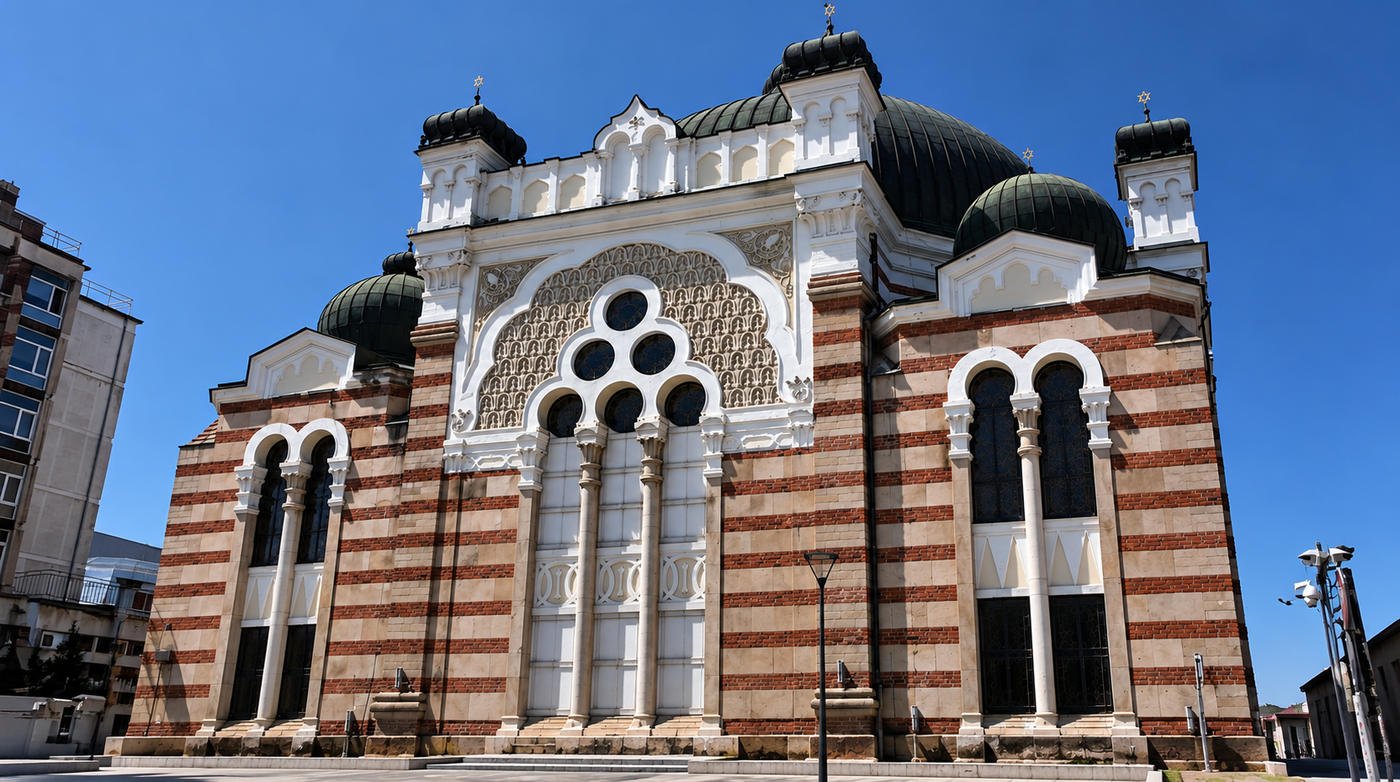
The exterior of the Sofia Synagogue is one of its most recognisable features. Alternating bands of brick and stone, decorative arches and a monumental central dome give the building a distinctive appearance within the historic centre.
The architecture combines Moorish-inspired ornamental details with Byzantine influences and elements associated with Viennese Secession. This mixture distinguishes the synagogue from Sofia’s nearby Orthodox churches and Ottoman-era mosque.
Look for the arched windows, symmetrical façade and smaller domed structures surrounding the main dome. These features reflect the architect’s attention to proportion and decorative detail.
The exterior is worth viewing from different angles along Exarch Joseph Street and the entrance courtyard. Its architectural details provide an introduction to the craftsmanship and artistic traditions found inside.
The Main Prayer Hall
The interior is one of the most memorable parts of a visit. The main prayer hall has an octagonal arrangement beneath a high central dome, with arches, columns and galleries creating a spacious setting.
Carrara marble columns, colourful Venetian mosaics and decorative painted surfaces contribute to the richness of the interior. Blue, green, gold and other colours appear throughout the decorative scheme.
The layout follows Jewish religious traditions, with the sacred furnishings and seating arranged for communal prayer. The architecture combines ornamental detail with the practical requirements of a functioning synagogue.
Take time to look upwards towards the dome and observe how the arches, columns and decorative surfaces fit together. The building’s scale becomes particularly apparent when viewed from the centre of the prayer hall.
As the synagogue remains active, visitor access may be affected by religious services and community events. Follow the instructions provided by synagogue staff.
The Great Brass Chandelier
One of the most striking interior features is the large brass chandelier suspended beneath the central dome. Made in Vienna, it weighs approximately 1,700 kilograms and forms a central element of the prayer hall.
Its ornate design complements the surrounding architecture and draws attention towards the centre of the room. The chandelier reflects the craftsmanship invested in the building and the importance of lighting within the interior.
Look at how it relates to the dome and the surrounding decorative surfaces. Smaller lighting elements around the galleries complement the central fixture and help create visual continuity throughout the hall.
The Ark, Marble Columns and Decorative Details
The aron hakodesh, or Torah ark, houses the Torah scrolls used during religious services. Positioned at the front of the sanctuary, it forms an important focal point within the prayer hall.
The ark stands within an ornate architectural setting, while the surrounding marble balustrade and decorative details emphasise its religious significance. The columns, arches and mosaic surfaces are also worth examining individually.
Together, these features demonstrate how the synagogue combines European architectural influences with the requirements and traditions of Jewish worship. Visitors can compare its interior with the nearby churches and mosque, each reflecting a different religious tradition.
The Niche Exhibition
The exhibition The Niche, located within the synagogue complex, introduces visitors to the history, daily life and cultural heritage of Bulgarian Jews.
Historical objects and interpretive displays explore Jewish religious traditions, community life and the development of Jewish institutions in Bulgaria. The exhibition also addresses the persecution experienced by Bulgarian Jews during the Second World War and the fate of Jewish communities from the territories deported in 1943.
The displays complement the building itself. While the synagogue’s architecture reflects the aspirations of Sofia’s Jewish community at the beginning of the twentieth century, the exhibition provides a broader perspective on the people who built, maintained and used it.
An interactive audio guide is available for individual visitors, offering further explanations of the exhibits and their historical context.
Allow additional time for the exhibition rather than treating the synagogue solely as an architectural attraction. Check the official website for current visiting arrangements.
The Synagogue’s Place in Sofia’s Historic Centre
The synagogue stands in a district where religious buildings, traditional markets, archaeological remains and public institutions reflect different periods of Sofia’s development.
Nearby Banya Bashi Mosque represents the city’s Ottoman architectural heritage, while the Ancient Serdica Ruins reveal its Roman origins. The Central Market Hall and Central Mineral Baths provide further insight into the development of Sofia during the late nineteenth and early twentieth centuries.
Walking between these attractions allows visitors to explore several aspects of the capital’s history without travelling far. The synagogue is particularly easy to include in a half-day exploration of central Sofia.
Best Time to Visit:
Spring and early autumn are pleasant times to explore central Sofia, with comfortable temperatures for walking between nearby attractions. The synagogue can also be visited in summer or winter, provided it is open to visitors. Check the official visiting schedule, as it closes to visitors on Bulgarian national holidays and Jewish holidays.
What to Visit Nearby:
The Sofia Synagogue is located in the historic centre, within walking distance of several important landmarks.
- Banya Bashi Mosque: Visit the sixteenth-century mosque known for its Ottoman architecture, central dome and minaret.
- Central Mineral Baths: Admire the historic building that houses the Regional History Museum of Sofia.
- Ancient Serdica Ruins: Explore archaeological remains of the Roman city, including ancient streets and building foundations.
- Central Market Hall: Visit the historic market building, with shops selling food and other goods.
- Saint George Rotunda: Discover one of Sofia’s oldest surviving buildings, dating to the early fourth century.
- Saint Sofia Church: Explore an ancient Christian basilica with a long history and an archaeological necropolis beneath it.
- Alexander Nevsky Cathedral: See Sofia’s most famous cathedral, known for its golden domes and richly decorated interior.
- Vitosha Boulevard: Continue towards the capital’s main pedestrian shopping street, with cafés, restaurants and shops.
Quick Travel Information:
Location: 16 Exarch Joseph Street, central Sofia, near Serdika metro station.
Visit duration: Allow around 30–60 minutes for the synagogue and exhibition.
Opening hours: The official website lists visiting hours as Sunday to Friday, 09:00–17:00. The synagogue closes to visitors on Bulgarian national holidays and Jewish holidays.
Admission: The official website lists individual admission to the synagogue and The Niche exhibition at €10, with reduced rates for students and seniors. Prices and arrangements may change.
Multi-day tour stop: Easily combined with Banya Bashi Mosque, the Central Mineral Baths and the Ancient Serdica Ruins during a visit to central Sofia.
Visitor etiquette: The synagogue is an active place of worship. Dress respectfully and follow staff instructions. If you wish to attend a religious service, contact the synagogue office at least three days in advance.
Useful Links
- Sofia Synagogue – Official Website
- Sofia Synagogue – History and Architecture
- The Niche Exhibition – Sofia Synagogue
- Sofia Synagogue – Visiting Hours and Admission
- Sofia Synagogue – Discover Sofia Official Tourism Website
- Visit Sofia – Official Tourism Website
Related Tours including Sofia: