Hindliyan House, Plovdiv, Bulgaria – Multi-Day Tour Stop
Location: 4 Artin Gidikov Street, Old Town, Plovdiv, south-central Bulgaria.
Type: Historic house museum / Bulgarian National Revival architecture / Armenian cultural heritage / Architectural and decorative arts landmark.
Hindliyan House is one of the finest examples of Bulgarian National Revival residential architecture in Plovdiv. Built between 1834 and 1835 for the wealthy Armenian merchant Stepan Hindliyan, the house is particularly famous for its beautifully painted interiors, impressive ceilings, decorative details and traditional bathroom. Unlike many historic buildings that have undergone substantial reconstruction, Hindliyan House has preserved much of its original architectural character.
The property reflects the lifestyle of a prosperous nineteenth-century merchant family and demonstrates the cultural influences that shaped Plovdiv during the Bulgarian National Revival. Its rooms are decorated with elaborate floral patterns, geometric designs and painted landscapes depicting distant European and Mediterranean cities. One of its most unusual features is the indoor fountain, which historically circulated rose water in the upper-floor reception hall.
Today, Hindliyan House operates as a museum and is one of the most interesting historic properties to explore in Plovdiv’s Old Town. Its architecture, artistic decoration and Armenian heritage make it a worthwhile stop for anyone interested in Bulgarian history and traditional urban houses.
Main Facts:
- Name: Hindliyan House, also known as Hindliyan’s House.
- Location: 4 Artin Gidikov Street, Plovdiv, Bulgaria.
- Construction: 1834–1835.
- Original owner: Stepan Hindliyan, a wealthy Armenian merchant.
- Architectural style: Bulgarian National Revival residential architecture.
- Architects and builders: Unknown master-builders.
- Interior decoration: Traditional wall paintings, decorative ceilings and landscape compositions.
- Notable features: Symmetrical design, indoor fountain, traditional bathroom and painted rooms.
- Historical significance: One of the best-preserved and most richly decorated houses in Plovdiv’s Old Town.
- Present use: House museum managed by the Municipal Institute Ancient Plovdiv.
Historical Importance:
Stepan Hindliyan and His Armenian Heritage
The house was built for Stepan Hindliyan, one of the most prosperous Armenian merchants in nineteenth-century Plovdiv.
He belonged to one of the four wealthiest Armenian families in the city and played an important role in its commercial life. His business activities extended well beyond Bulgaria, with frequent journeys to India to conduct trade.
According to the official historical account, his connections with India contributed to the nickname Hindliyan, which eventually became the family name associated with the house.
The Armenian community was an important part of Plovdiv’s multicultural society during the Bulgarian National Revival. Alongside Bulgarian, Greek, Jewish and other communities, Armenian merchants and craftsmen contributed to the city’s economic and cultural development.
Hindliyan House reflects this prosperous period, demonstrating how wealthy merchant families combined traditional domestic arrangements with influences acquired through international trade and travel.
Construction and Architectural Design
Hindliyan House was constructed between 1834 and 1835 by unknown master-builders.
It is particularly notable for its symmetrical architectural arrangement, a characteristic found in some of the most important residential buildings of the Bulgarian National Revival period.
The building was designed around a central internal arrangement, with rooms connected through a spacious entrance hall and an impressive staircase leading to the upper floor.
Although the property occupies an irregular plot, its architectural composition maintains a remarkable sense of balance and symmetry.
The house also includes several additional structures within its courtyard, reflecting the practical requirements of a wealthy nineteenth-century household.
These included service buildings, a kitchen, storage facilities, a laundry area and accommodation for servants.
The combination of residential, commercial and household spaces demonstrates how prosperous merchant families organised their daily lives.
The Artistic Decoration and Painted Interiors
One of the most important characteristics of Hindliyan House is its exceptionally rich decorative artwork.
Unlike simpler Revival houses, where decoration was often concentrated around the main reception rooms, Hindliyan House features elaborate paintings throughout much of its interior.
Two talented painters were responsible for the artistic decoration, one of whom was reportedly of Italian descent.
Their work included floral ornaments, geometric patterns, decorative columns, garlands and architectural compositions.
The paintings also incorporated landscapes depicting distant cities, including Constantinople, Venice, Alexandria, Saint Petersburg, Stockholm and Lisbon.
These images are particularly interesting because they reflect the international connections and geographical awareness of the wealthy merchant who commissioned the house.
The decoration of the first-floor walls is also notable for the use of paper stencils, a technique identified in the official historical description as an early example of this approach in the city’s residential architecture.
The ceilings were individually painted to complement the decoration of each room, creating a distinctive atmosphere throughout the building.
The Traditional Bathroom and Heating System
Another remarkable feature of Hindliyan House is its traditional bathroom, located on the ground floor.
The installation was designed according to principles associated with the Roman hypocaust heating system, later developed into the Turkish hammam tradition.
The space included arrangements for heating and creating steam, providing a more comfortable bathing environment during the colder months.
Such facilities were unusual in ordinary nineteenth-century homes and demonstrate the prosperity of the Hindliyan family.
The bathroom is particularly interesting because it illustrates how architectural ideas from different historical and cultural traditions were incorporated into domestic life in Plovdiv.
The House During the Later Periods
Hindliyan House has survived more successfully than many historic properties in Plovdiv, retaining much of its original architectural arrangement and decorative character.
Over the years, the building became an important example of the city’s nineteenth-century residential architecture.
Its historical and artistic value eventually led to its preservation as part of the Old Town’s architectural heritage.
Today, it operates as a museum under the management of the Municipal Institute Ancient Plovdiv, allowing visitors to explore the rooms and discover the lifestyle of a wealthy Armenian merchant family during the Bulgarian National Revival.
What to See:
The Exterior Façade and Courtyard
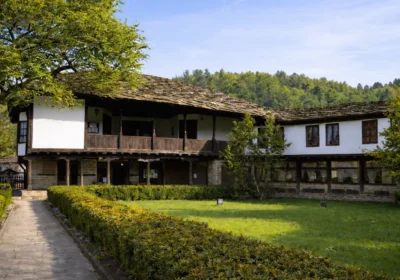
The exterior of Hindliyan House immediately attracts attention with its distinctive appearance and carefully maintained architectural details.
The building features a symmetrical composition, projecting upper-floor elements and decorative painted sections.
Its courtyard provides a pleasant introduction to the property, revealing how the main residential building was connected with the surrounding service structures.
The arrangement also reflects the traditional organisation of wealthy urban homes in nineteenth-century Plovdiv, where the courtyard served as an important private living and working space.
The Spacious Upper-Floor Hall – Hayet
One of the highlights of the house is the spacious upper-floor hall, traditionally known as the hayet.
This central reception area was an important part of family and social life, providing a place for welcoming guests and conducting household activities.
The room is particularly impressive because of its decorative wall paintings, elaborate ceiling and ornamental details.
Its most unusual feature is the indoor fountain, which historically circulated rose water throughout the hall.
This detail provides an interesting glimpse into the lifestyle of wealthy nineteenth-century families, who used fragrance, decoration and architectural design to create an elegant domestic environment.
The Painted Rooms and Landscape Scenes
The individual rooms of Hindliyan House are among its greatest attractions.
Their walls and ceilings feature different decorative compositions, including flowers, garlands, geometric patterns and painted architectural details.
Some of the most interesting paintings depict European and Mediterranean cities, offering a glimpse of the geographical world familiar to the merchant through his travels and commercial activities.
The landscapes of Venice, Constantinople, Alexandria and other distant destinations give the rooms a distinctive character.
The variety of decoration also means that each room has its own visual identity rather than following one uniform design.
The Indoor Fountain and Rose Water Feature
The indoor fountain is one of the most memorable details of Hindliyan House.
Located in the upper-floor hall, it was designed to circulate rose water, filling the reception area with a pleasant fragrance.
The feature is particularly unusual because it combines practical household arrangements with decorative architecture.
Following restoration work, the circulation of rose water was reinstated, helping visitors appreciate how the fountain would have contributed to the atmosphere of the original home.
The Traditional Bathroom
The bathroom is another highlight of the visit and an important architectural feature of the house.
Its heating arrangement followed principles associated with the Roman hypocaust system and the later Turkish hammam.
Visitors can see how the bathing space was incorporated into the domestic layout and how the family enjoyed facilities that were relatively uncommon in ordinary nineteenth-century homes.
It is a particularly interesting detail for anyone studying the development of domestic architecture and traditional bathing culture.
The Storage Building and Service Areas
The courtyard also contains a separate stone storage building known as a maaza.
It was used to keep valuable household possessions and other goods safely stored.
One unusual decorative feature is the painted representation of the main house above the storage building’s entrance.
A similar painted composition appears above the kitchen entrance, illustrating how the decorative programme extended beyond the main residential rooms.
These smaller details help visitors understand that the artistic design of Hindliyan House was carefully planned across the entire property.
Best Time to Visit:
Hindliyan House can be visited throughout the year, making it a suitable attraction regardless of the season.
Spring and autumn are particularly pleasant periods for exploring Plovdiv’s Old Town, when temperatures are comfortable for walking between its historic houses, churches and archaeological landmarks.
Summer is also a good time to visit, although the cobbled streets and outdoor areas can become hot during the afternoon.
Winter offers a quieter experience, with the interior decoration providing an interesting cultural attraction on colder days.
The house is particularly enjoyable as part of a walking tour of the Old Town, allowing visitors to discover several Bulgarian Revival properties in one outing.
What to Visit Nearby:
Hindliyan House is situated in the architectural and historical reserve of Old Plovdiv, surrounded by several important cultural and historical attractions.
- Balabanov House: Another beautifully preserved Bulgarian Revival residence, famous for its spacious interior, decorative ceilings and cultural exhibitions.
- Kuyumdzhioglu House – Regional Ethnographic Museum: One of the most impressive historic buildings in Plovdiv, housing collections of traditional Bulgarian clothing, crafts, household objects and regional customs.
- Lamartine House: A historic Revival property associated with French poet Alphonse de Lamartine, who stayed there during his travels through Bulgaria in 1833.
- Ancient Theatre of Philippopolis: One of the best-preserved Roman theatres in the Balkans, still used for concerts, theatrical performances and cultural events.
- St Constantine and Helena Church: One of the oldest Christian churches in Plovdiv, featuring an impressive iconostasis, religious paintings and a beautiful courtyard.
- Nebet Tepe: An archaeological site on one of Plovdiv’s famous hills, preserving remains of prehistoric, Thracian and medieval settlements.
- Roman Stadium: An impressive ancient sports facility located beneath Dzhumaya Square, once used for athletic competitions and public events.
- Dzhumaya Mosque: A prominent Ottoman-era religious building in the centre of Plovdiv, known for its impressive interior decoration.
- Ancient Synagogue of Philippopolis: An important archaeological discovery providing evidence of the Jewish community that lived in Roman Plovdiv. Its surviving mosaic decoration is displayed at the Regional Archaeological Museum.
Quick Travel Information:
Location: 4 Artin Gidikov Street, Old Town, Plovdiv, Bulgaria.
Recommended visit duration: Approximately 30–45 minutes to explore the house, its painted rooms, courtyard and distinctive architectural features. Allow additional time for visiting neighbouring historic houses.
Visitor advice: Comfortable walking shoes are recommended because the Old Town has cobbled streets and uneven stone surfaces. Photography policies may vary inside the house, so check with museum staff before taking photographs. Cars have limited access to parts of the Old Town, making walking the best way to explore the area.
Hindliyan House is an excellent addition to a multi-day tour of Plovdiv and Bulgaria. Its visit can easily be combined with Balabanov House, Lamartine House and the nearby Kuyumdzhioglu House, creating a particularly interesting exploration of Bulgarian Revival architecture.
For a full-day itinerary, visitors can continue towards the Ancient Theatre, Roman Stadium, Dzhumaya Mosque and the Regional Archaeological Museum. The second day can include the Bishop’s Basilica, Small Basilica, Ancient Synagogue mosaics and Kapana district.
Those exploring the wider region can continue towards Asenovgrad and Bachkovo Monastery or travel towards the Thracian heritage sites near Kazanlak.
Hindliyan House is especially worthwhile for visitors interested in historic architecture, traditional interiors and the multicultural heritage of Plovdiv. It offers a more intimate experience than the city’s large archaeological monuments, bringing the everyday life of a prosperous nineteenth-century merchant family into focus.
Useful Links:
- Hindliyan House – Official Website
- Visit Plovdiv – Hindliyan House
- Ancient Plovdiv – Official Website
- Hindliyan House – Location on Google Maps
- Plovdiv – Weather Forecast
Related Tours including Balabanov House: